
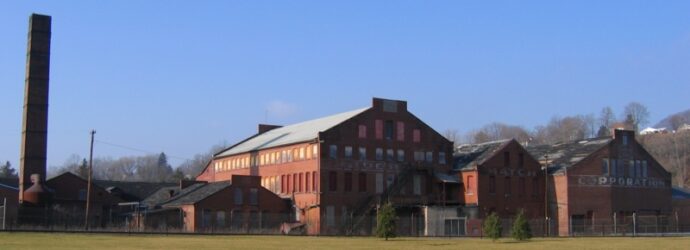
The Pennsylvania Match Company, now the home of the APS, never did produce any private die proprietary (match) stamps.
They didn’t start producing matches until 1900. The law requiring the stamps was repealed in 1883.
🧭 About the Pennsylvania Match Company
The Pennsylvania Match Company, known locally as the Match Factory, was founded in 1899 by Col. W. Fred Reynolds, Joseph L. Montgomery and S. A. Donachy with $200,000 of their own money in Bellefonte, Pennsylvania.
A 31,000 square feet brick building was constructed in Bellefonte, Pennsylvania somewhere around late 1899, and production began in 1900, employing around or more than 300 people. By 1911, the company was one of the eight largest producers of wooden matches in the US.
At its peak during World War II, the factory employed almost 400 workers and merged with Universal Match Corporation. According to the Bellefonte Historical and Cultural Association, the business “closed in 1947 due to competition from book matches and cigarette lighters.”


The red brick buildings were then purchased by lumber and building supply company M. L. Claster & Sons for their General Offices and Bellefonte storage, adding to adjacent land they already owned. After Clasters was sold to YBC in 1997, the site stood vacant for several years until the American Philatelic Society, looking for more space at lower cost, purchased the complex in 2002, renovated the largest building, and relocated from State College.
The APS then refurbished the adjacent structure, making space available for other commercial tenants, and stated its intention to rehabilitate the remaining buildings eventually.
It was listed on the National Register of Historic Places in 2001.
🧭 Why Pennsylvania Match Co. never issued private‑die match stamps
Private‑die match stamps existed only between 1864 and 1883, any company founded after that window — including Pennsylvania Match — could not have produced them.
- The federal proprietary tax on matches, medicines, and perfumes was repealed in 1883.
This ended the entire era of private‑die proprietary stamps for match manufacturers. - The Pennsylvania Match Company did not begin producing matches until 1900.
By then, the tax had long been gone, and no match manufacturer in the U.S. was producing or using proprietary stamps anymore.
🧾 What were private‑die match stamps
Private‑die proprietary stamps were special revenue stamps engraved with the manufacturer’s own design, but printed under federal supervision. Match companies such as Diamond, Swift, and others used them to pay the War Revenue taxes of the Civil War era and the later continuation of the proprietary tax.
Key characteristics:
- Required for matches, medicines, and perfumery
- In use 1864–1883
- Designs were company‑specific
- Printed by the Bureau of Engraving and Printing or approved private engravers
- Ended abruptly when Congress repealed the tax in 1883
After the repeal, match companies had no legal reason to use or produce such stamps.

It is not certain that the Penn Company manufactured matches. It may have been a distributorship for Canadian or English matches, as the company name includes “Limited.” The stamps were issued from October 31, 1881 until February 14, 1883. 3,696,000 were issued on watermarked paper.


