
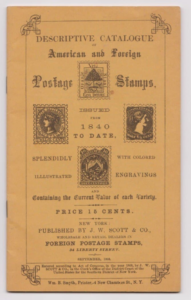
When the first Scott catalog appeared in 1868, there were no catalog numbers assigned to the stamps. When then, 1887 (or was it). And the rest is history.
The History of the Scott Stamp Catalogue
The Scott Catalogue is the dominant stamp‑identification and valuation system in North America, used by virtually every U.S. collector, dealer, and exhibitor. Its evolution mirrors the growth of organized philately itself.
🏛️ Origins (1868)
- The first Scott catalogue appeared in September 1868, created by New York stamp dealer J.W. Scott.
- It was a 21‑page pamphlet that listed stamps by country and descriptively but did not yet use a numbering system.
- It was titled: “Descriptive Catalogue of American and Foreign Postage Stamps, issued from 1840 to Date, Splendidly Illustrated with Colored Engravings and Containing the Current Value of Each Variety.”
- Even in this earliest form, it attempted to list all stamps of the world and assign market prices, establishing the model for all future editions.
Late 1860s–Early 1870s — Experimental Numbering
- In the 1869 and 1870 editions, Scott began experimenting with primitive numbering schemes.
- These early numbers were not yet standardized, and formats varied between editions.
1870–1872 — The First Recognizable Scott Numbering System
- By 1870–1872, Scott introduced a consistent, sequential numbering system for each country.
- This is the point at which collectors and historians generally agree that “Scott numbers” truly begin.
Mid‑1870s — System Becomes Stable
- By the mid‑1870s, Scott’s numbering had become:
- Sequential
- Country‑organized
- Stable enough to be used by dealers and collectors
- This is the direct ancestor of the modern Scott numbering system.

📚 Growth Through the Late 19th & Early 20th Century
- As global stamp issues exploded, Scott expanded the catalogue into larger, regularly updated volumes.
- The catalogue became the standard reference for U.S. collectors, and its numbering system—Scott numbers—became the default language of American philately.
📖 Mid‑Century to Modern Expansion
- By the mid‑20th century, Scott was publishing multi‑volume world catalogues and specialized editions.
- The catalogue eventually came under the ownership of Scott Publishing Co., later a subsidiary of Amos Press (now Scott Stamp LLC).
- The numbering system became so dominant that U.S., Canadian, and Mexican collectors overwhelmingly rely on it for identification.


📘 The Modern Scott Catalogue (21st Century)
Today, the catalogue is a massive, annually updated reference system:
🔹 World Catalogues
- As of recent editions, Scott publishes 14 large volumes covering:
- Every country that has ever issued stamps
- A U.S. Specialized Catalogue
- A Classic Specialized 1840–1940 volume

🔹 U.S. Specialized Catalogue
- The Scott Specialized Catalogue of United States Stamps and Covers is the best‑selling and most detailed volume.
- It includes:
- Postage stamps
- Postal stationery
- Revenues
- Duck stamps
- Booklets & panes
- Carriers & locals
- Confederate States
- U.S. possessions

🔹 Digital Editions

- Scott now offers digital subscriptions, searchable online databases, and downloadable formats—reflecting the shift toward digital philatelic research.
🔢 Why Scott Numbers Matter
- Scott numbers provide a universal, standardized identification system for nearly every stamp ever issued.
- They are essential for:
- Buying and selling
- Album organization
- Exhibiting
- Research and valuation
🧭 Scott vs. Market Values
- Scott values are editorial estimates, not real‑time market prices.
- Many collectors now pair Scott numbers with actual sales‑based valuations from online tools and auction data.
🏁 In Summary
The Scott Catalogue began as a modest 21‑page price list in 1868 and has grown into the most influential philatelic reference system in North America, shaping how collectors identify, organize, and value stamps for more than 150 years.