
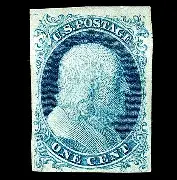
The number of different Scott numbers for the 1851 series, 5-9, 13-16, 18-24, and 31-34 came from a group of dealers who were looking for more stamps for collectors to collect to be able to sell more. Afterall, there were not very many different stamps yet in the 1860s.
Stamp dealers were making the most of a small number of stamps
Differences Between Scott #5–#9

he 1851 1¢ Franklin issue is famous for its type variations, and value depends almost entirely on how much of the original design remains. Two stamps with the same portrait can differ by thousands of dollars based solely on:
- Ornament completeness
- Plate state
- Re‑cut vs. uncut lines
- Position on the plate
Scott #5 is the standout rarity because it is the only position where the full design survived.
| Scott # | Type | Design Characteristics | Notes |
|---|---|---|---|
| #5 | Type I | Full design, complete ornaments | Extremely rare; only one plate position |
| #6 | Type Ia | Nearly complete ornaments | Scarce |
| #7 | Type II | Full bottom, trimmed top | More common |
| #8 | Type III | Both top & bottom heavily trimmed | Distinctive “open” look |
| #9 | Type IV | Re‑cut frame lines | Only type with re‑engraving |
The rarest of the series. Only one position on Plate 1 Early (7R1E) produced a stamp with the entire design fully intact, including all top and bottom ornaments. Fewer than 100 examples are known. Key trait: Full scrollwork visible at top and bottom.
Shows almost the full ornamentation, but not as complete as Type I. Produced from limited positions on Plate 1 Early and Late. Key trait: Nearly full ornaments; more complete than Type II–IV.
The bottom ornaments remain fully intact, but the top ornaments were trimmed away when the design was reduced to fit the plate. Key trait: Full bottom scrolls; top scrolls partially cut.
Both top and bottom ornaments were significantly cut away due to aggressive design trimming. Key trait: “Open” appearance at top and bottom.
Unique in the group because the engraver re‑cut and strengthened lines in the frame to improve worn impressions. Key trait: Noticeably sharper, heavier frame lines from re‑engraving.
Differences Between Scott #13–#16

Just like the 1¢ Franklin types, the 10¢ Washington issue varies dramatically in value depending on how much of the original design remains and whether the stamp shows re‑cut lines. Collectors prize Type I (#13) for its complete ornaments and early impressions, while Type IV (#16) is sought after for its bold, re‑engraved frame.
| Scott # | Type | Design Characteristics | Notes |
|---|---|---|---|
| #13 | Type I | Full design, complete ornaments | Scarce; early plate impressions |
| #14 | Type II | Trimmed top & bottom | More common |
| #15 | Type III | Heavily trimmed design | Distinctive “open” look |
| #16 | Type IV | Re‑cut frame lines | Only type with re‑engraving |
The only type showing the full original design, including complete top and bottom ornaments. Printed from early impressions of Plate 1. Key trait: Full scrollwork visible at both top and bottom; strongest, cleanest impressions.
The design was cut down to fit the plate, removing portions of both top and bottom ornaments. More common than Type I. Key trait: Noticeably reduced ornaments at both top and bottom.
Shows even more aggressive trimming than Type II. Top and bottom ornaments are significantly cut away, giving the stamp a more “open” appearance. Key trait: Very reduced ornamentation; top and bottom appear open.
The engraver re‑cut lines in the frame to strengthen worn areas of the plate. This is the only type with intentional re‑engraving. Key trait: Sharper, heavier frame lines; strengthened outer lines.
Differences Between Scott 18–#24

The 12¢ Washington issue mirrors the 1¢ and 10¢ series: value depends almost entirely on how much of the original design remains and whether the stamp shows re‑cut lines. Type I (#18) is prized for its complete ornaments, while Types IV and V (#21 and #24) are sought after for their bold re‑engraved frames.
| Scott # | Type | Design Characteristics | Notes |
|---|---|---|---|
| #18 | Type I | Full design, complete ornaments | Scarce; early impressions |
| #19 | Type II | Trimmed top & bottom | More common |
| #20 | Type III | Heavily trimmed design | Distinctive “open” look |
| #21 | Type IV | Re‑cut frame lines | Only type with full re‑engraving |
| #22 | Type II (late) | Trimmed ornaments; worn plate | Softer impressions |
| #23 | Type III (late) | Open design; worn plate | Lines appear weaker |
| #24 | Type V | Selective re‑cutting | Unique frame strengthening |
Shows the full original design, including complete top and bottom ornaments. Printed from early impressions of Plate 1. Key trait: Full scrollwork at both top and bottom; strongest early impressions.
The design was cut down to fit the plate, removing portions of both top and bottom ornaments. More common than Type I. Key trait: Reduced ornaments at both top and bottom.
Shows more aggressive trimming than Type II. Top and bottom ornaments are significantly cut away, giving the stamp a more “open” appearance. Key trait: Very reduced ornamentation; open top and bottom.
The engraver re‑cut lines in the frame to strengthen worn areas of the plate. This is the only type with intentional re‑engraving. Key trait: Sharper, heavier frame lines; strengthened outer lines.
A later state of the Type II design. Shows trimming similar to #19 but with lighter impressions due to plate wear. Key trait: Trimmed ornaments with softer, worn impressions.
A late‑state version of Type III. Still heavily trimmed, but impressions are weaker and lines appear less sharp. Key trait: Open top/bottom with noticeably worn plate lines.
A unique re‑cut variety where the engraver strengthened specific frame elements, creating a distinct appearance separate from Type IV. Key trait: Selective re‑cutting; certain frame lines appear bold while others remain light.
Differences Between Scott #31–#34

Scott #31–34 mark the transition from imperforate to perforated production, and collectors prize them for how they preserve (or alter) the original 1851 design. Type IV (#34) is especially desirable because its re‑cut lines create a bold, distinctive appearance not found in the other perforated types.
| Scott # | Type | Design Characteristics | Notes |
|---|---|---|---|
| #31 | Type I | Full design, complete ornaments | Early perforated issue |
| #32 | Type II | Trimmed top & bottom | Centering often tight |
| #33 | Type III | Heavily trimmed design | Late‑state impressions |
| #34 | Type IV | Re‑cut frame lines | Only type with re‑engraving |
The perforated version of the earlier imperforate Type I. Shows the full original design, including complete top and bottom ornaments, but impressions vary due to plate wear. Key trait: Full scrollwork; early perforated issue.
Design was trimmed at top and bottom, just like the imperforate Type II. Perforations often cut close to the design, making well‑centered examples scarce. Key trait: Reduced ornaments; perforations frequently tight.
Shows heavier trimming than Type II, with top and bottom ornaments significantly cut away. Perforated examples often show uneven impressions due to late plate wear. Key trait: Very open top and bottom; late‑state impressions.
The only perforated 10¢ type with re‑cut frame lines, strengthening worn areas of the plate. Lines appear sharper and heavier than Types I–III. Key trait: Bold, strengthened frame lines; distinctive re‑engraving.