
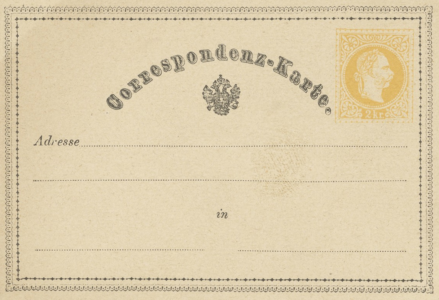
Austria-Hungary was the first country to issue a postal card (Correspondenz-Karte) on October 1st, 1869. The U.S> didn’t issue a postal card until 1873.
The world’s first official postal card, the Correspondenz-Karte (see featured image above), was issued by Austria-Hungary on October 1st, 1869. Proposed by economist Dr. Emanuel Herrmann (Fig. 1) as an affordable, quick, and efficient means of communication, these early cards featured a pre-printed stamp, were light yellow in color, and did not have pictures.
Key Details of the First Postal Card (1869):
- Name: Correspondenz-Karte (Correspondence Card).
- Release Date: October 1st, 1869.
- Creator/Origin: Proposed by Dr. Emanuel Herrmann; issued by the Austrian Post Office.
- Design: Plain,, no pictures (unlike modern postcards), with a pre-printed stamp to show prepaid postage.
- Languages: Produced in multiple languages, primarily German and Hungarian, to accommodate the multilingual empire.
- Cost: Sold for half the price of a standard letter, making them highly popular for short messages.
- Usage: Over two million cards were sold within the first three months of release.
These cards were designed to be simple, with space for a message on one side and the address on the other. Their success led to the rapid adoption of postal cards across the world, with other countries issuing their own versions by 1870.

U.S. Postal Cards
The U.S. apparently took its time because it was thought that people might send embarrassing messages on the back of the postal card. Congress also was slow to act, waiting until Aug. 8, 1872, to authorize issuing postal cards and finally appropriating funds for development and printing four months later.
The first official U.S. postal card (Scott UX1, fig. 2) was issued by the Post Office Department on May 12th, 1873, featuring a one-cent brown imprinted stamp with an image of Liberty inside an oval frame. These government-produced cards were used for concise correspondence, costing only one-third of the price of a standard letter.
The first card was released in a second version (Scott UX3) of the same design on July 6, 1873. The size of the “U.S.P.O.D..” monogram watermark distinguishes the two cards. The watermark on the UX1 is 90mm by 60 mm (fig. 3), while on the second (UX3) it is 53mm by 36mm. The second version is much more plentiful and less costly to purchase.
Key details regarding the first U.S. postal card:
- Release Date: The cards debuted on May 12, 1873, in Springfield, Massachusetts, and were released in major cities like Boston, New York, and Washington, D.C., shortly after.
- Design & Rate: The card featured a 1-cent brown, preprinted “indicium” (postage) of the Goddess of Liberty on buff-colored paper.
- Purpose: They were designed as an economical way to send short, non-confidential messages, often called the “email of its day”.
- Distinction: Unlike privately printed postcards of that era, which required 2 cents postage, the government-issued “postal cards” only required 1 cent.
- Usage: They were instantly popular; 31 million were sold by June 30, 1873, just two months after their introduction.
These cards are highly collectible, with early, unwatermarked versions being particularly rare.
On September 14th, 1973, the UX65 (fig. 4) was issued as a 6-cent reproduction of the UX1 to celebrate the U.S. postal cards 100th anniversary.


(Image Credit: Wayne Youngblood)

About Postal Cards
Postal cards (Scott Category UX) are postal stationery (Scott Category U) with an imprinted stamp or indicium signifying the prepayment of postage. They are sold by postal authorities. On January 26, 1869, Dr. Emanuel Herrmann of Austria described the advantages of a Correspondenz Karte. By October 1, 1869, the world’s first postal card was produced by Austria-Hungary. They caught on quickly. By the end of 1870, Great Britain, Finland, Switzerland, and Württemberg joined the countries issuing postal cards. In the United States, they were first produced in 1873. Some of the forms taken by postal cards include the regular single card, which may be commemorative or definitive, attached message-reply cards (Scott Category UY), airmail postal cards (Scott Category UXC), and official postal cards (Scott Category UZ) used for official government business with a “penalty for private use”.
To the post office, there were positive advantages to postal cards as opposed to correspondence in envelopes. The cards were lighter and less bulky than letters, and they were all the same size. The result was that they occupied less than one-third of the space required by the same number of letters. To the public, there were also advantages. They were simple and cheap, making them an instant success. Britain had a half-penny rate to begin with. The U.S. “penny postcard” rate lasted through 1951.
Presumably for the purpose of getting a prompt reply, a sender was given the opportunity to pay for postage both ways with an attached message-reply card, first introduced by Germany in 1873. Other European countries quickly followed suit. Spain furnished message-reply cards to her Colonies: Cuba (1880), Philippines (1889) and Puerto Rico (1898). The U.S. issued them first in 1892. Message-reply cards were attached tête-bêche and likely to be perforated or rouletted to facilitate separation once in the hands of the recipient. The recipient could then tear them apart and use the prepaid reply card to correspond with the original sender. Normally, the message card would be identical to the reply card except with the distinction of having additional language such as “WITH REPLY CARD” or “La otra tarjeta es para la respuesta” or “Carte Postale Réponse” or similar words to distinguish the two. In the U.S., message and reply cards have been identical since 1968.
Nowadays, the term postal card is clearly differentiated from the term ‘postcard’, which designates cards prepared by private companies and which do not have prepaid franking. Postcards are available at commercial outlets; the addition of a postage stamp is required to mail them, and they are frequently illustrated with pictures or printed advertisements; they are not considered postal stationery. Historically, however, this terminological distinction was not evident: in the UK, the term ‘postcard’ was used for what was called in the U.S. a ‘postal card’.
United Postal Stationery Society
Click here for more information on the United Postal Stationery Society

The United Postal Stationery Society (UPSS) was formed July 1st, 1945 from the merger of the Postal Card Society of America, in existence since 1891, and the International Postal Stationery Society, founded in 1939. Current membership stands at about 1,000. The organization’s journal, since 1949, has been called Postal Stationery. Articles appear around new issues of U.S. and international postal stationery, plus articles on rare and unusual stationery.
The Society has been active in producing postal stationery publications in the form of handbooks, catalogs and manuscripts since 1955. It also conducts regular auctions and a sales circuit. It regularly awards outstanding exhibits. Members have access to over 70 years of the society’s journals online, beginning with Vol. 1, No. 1, May-June 1948, plus a complete hi-resolution scan of every die used in the manufacture of US stamped envelopes.