Alex Haimann – APS Top Recruiters 2020
Aug. 8th, 2021
Alex Haimann has been recognized by the APS as the APS Top Recruiter for 2020
Aug. 8th, 2021
Alex Haimann has been recognized by the APS as the APS Top Recruiter for 2020

In mid-1927 the entire world, and certainly St. Louis, celebrated Charles “Lucky” Lindbergh for his daring flight across the Atlantic. The flight won him not only fame but also fortune—the $25,000 Orteig prize which had gone unclaimed since it was first offered in 1919. But had it not been for a Spanish Air Mail stamp issued in 1930, we might never have known of Lindbergh’s cat, Patsy.
The 1 Peseta air mail stamp commemorating Lindbergh’s flight was issued October 10, 1930 in Seville, Spain; one of a series of eight for the Spanish-American Exhibition, or World’s Fair, held that year. It features a vignette of Lindbergh, the Statue of Liberty, the Spirit of St. Louis, and Patsy’s silhouette–what is thought to be the first domestic cat featured on postage– looking on at the departing plane.

Numerous articles assert that Patsy was a frequent passenger on Lindbergh’s flights and could often be found curled up in his plane’s tail in the hangar. When asked why Patsy did not join him for the famed trans-Atlantic flight, however, Lindbergh stated, “It’s too dangerous a journey to risk the cat’s life.” Instead he opted to take a “Felix The Cat” doll (from the 1919 Feline Follies cartoon) as his mascot.

The air mail stamp itself was created using two plates; one for the vignette of Lindbergh, with the second plate containing the remainder of the design. This resulted in the printing of many unauthorized versions, including these examples:

It was 22 years later before the next cat appeared on a postage stamp. In fact, cats did not become common on stamps until the 1960s, although the American Topical Association now lists 2,968 cat stamps in 37 categories (mostly based on breed).
Authored By: Edward Bayham
In the February 2021 issue of the Perf-Dispatch, John Marquardt described the role of the Royal Navy in
transferring British gold reserves to Canada for safe keeping during WW II. Did you know that the U.S.
Navy played a role as well?
Germany invaded France, Holland, and Belgium on May 10, 1940. 405 tons of French gold reserves were
removed to Halifax Canada on a French aircraft carrier and two fast cruisers. Another 212 tons of gold
were transported to Casablanca in French Morocco on May 28 and transferred to the U.S. Navy’s
armored cruiser U.S.S. Vincennes (CA-44) that brought it to New York. The illustrated cover documents the
ship’s return via the Azores.

In March 1941 the U.S.S. Vincennes called on Pernambuco, Brazil and continued on to Cape Town, South
Africa. It returned to New York City with ₤67.5 million in British gold bullion to pay for arms purchased
from the United States under the Lend Lease Act of March 1941.

These are the instructions and use case for the Member Search widget.
The Sonic Imagery Labs Precision U.S. Specialty Multi Gauge combines 12 precision measuring devices in one easy to use instrument. This gauge has been expressly created for US stamp collectors but can be used were applicable.
In a “What Is It?” article in last month’s Perf- Dispatch, I raised a question about three Public Herald labels that I discovered in an old stock book. I was curious about the labels, and I wondered what they might be.
Since then I have spent some time researching Public Herald labels. I sent letters of inquiry to four dealers, people who might be able to tell me about the labels or who might put me in touch with someone who could help me.
I also spent time online—lots of time. And it was during my online research that I discovered—almost by accident—that there was an article titled The Public Herald “Seals” that appeared in the January – February 2009 (Volume: 88 Number:1) issue of the COLLECTORS CLUB PHILATELIST, a publication that I was unaware of. I sent an email off to the APRL to see if this was a journal that might be in the library. Marsha Garman found the journal, and emailed me a copy of the article.

Jim Kotanchik
The five-page article was written by Jim Kotanchik, who I can only describe as a truly eminent philatelist. His article, The Public Herald “Seals”, answered some but not all of my questions. I decided to contact Jim Kotanchik, only to learn that he died in 2011. Kotanchik authored POST OFFICE SEALS OF THE UNITED STATES AND POSSESSIONS (ISBN-10: 0977654907). This is a massive 350-page book, and it is wickedly expensive, but I hope to find a discounted copy. Note that I am now referring to the Public Herald labels as “seals”, not “labels”.
It was about this same time that Eric Jackson, one of the dealers I contacted, sent me a copy of an article by Jim Kotanchik that appeared in THE OFFICIAL SEAL NEWSLETTER (date unknown). Another publication unknown to me. This article, also titled “The Public Herald Seals”, appears to be an earlier version of what was printed in the issue of the COLLECTORS CLUB PHILATELIST.
Kotanchik tells us that the Public Herald seals were the work of Louis Lum Smith, a Philadelphia publisher (the PUBLIC HERALD and the AGENT’S HERALD). They were, in effect, post office seals that were provided to fourth class post offices as a kind of gimmick to encourage subscriptions to Smith’s two newspapers.
At our September club meeting I’ll have more information and copies of the COLLECTORS CLUB PHILATELIST article. I will also have the Public Herald seals and some covers/cards to share with you—“show and tell”. My thanks to Phil Schorr for continuing to encourage me in my effort to uncover the story behind the Public Herald seals, and to Nathan Esbeck who discovered a Public Herald seal on a cover offered on Ebay.
Editor’s Note: One of our surmises at the last meeting, the one concerning bundling, was mostly correct. However, there is more to the story. Don’t miss hearing more at our upcoming meeting.
Some months back I purchased a “used” stockbook through eBay (where else?). I thought I was buying an empty stockbook, but when it arrived I was surprised to discover that it contained a collection of approximately fifty cut squares – some from the 1800s (anybody interested in these?), an old American Philatelic Association Sales Department Control stamp, and three old Philadelphia Public Herald labels (two overprinted POSTMASTER, ROHNERVILLE, Humboldt Co., CAL., and one overprinted POSTMASTER, CHINA FLAT, Humboldt Co., CAL).


Motivated by the basic philatelic principle that “one collector’s junk is another’s treasure”, I brought these labels to our February stamp club meeting. We have some pretty knowledgeable people in our club, but no one who saw them had any idea as to what they might be.
An online search drew a blank.
I have sent an enlarged computer-generated photocopy of the three labels to several dealers with the hope that someone will be able to tell me about them.
Most of us have a “what is it?” somewhere in our collections, and some of us have more than one. I have given this note and a computer-generated photocopy of the three labels to Phil for inclusion in a future newsletter. Let me know if you can answer my “what is it?” question. I will let you know what, if anything, dealers have to say about these three labels.
Since the original article, John Deutch has completed additional research and found a few answers about these labels. The APRL Library was able to produce and send the 5 page philatelic article about the labels that John was able to locate. John will talk about to what he learned at the September 2020 meeting. There will also be a summary of the article in the September Perf-Dispatch. Anyone that would like a copy of the full article can reach out to John Deutch.
by Alex Haimann
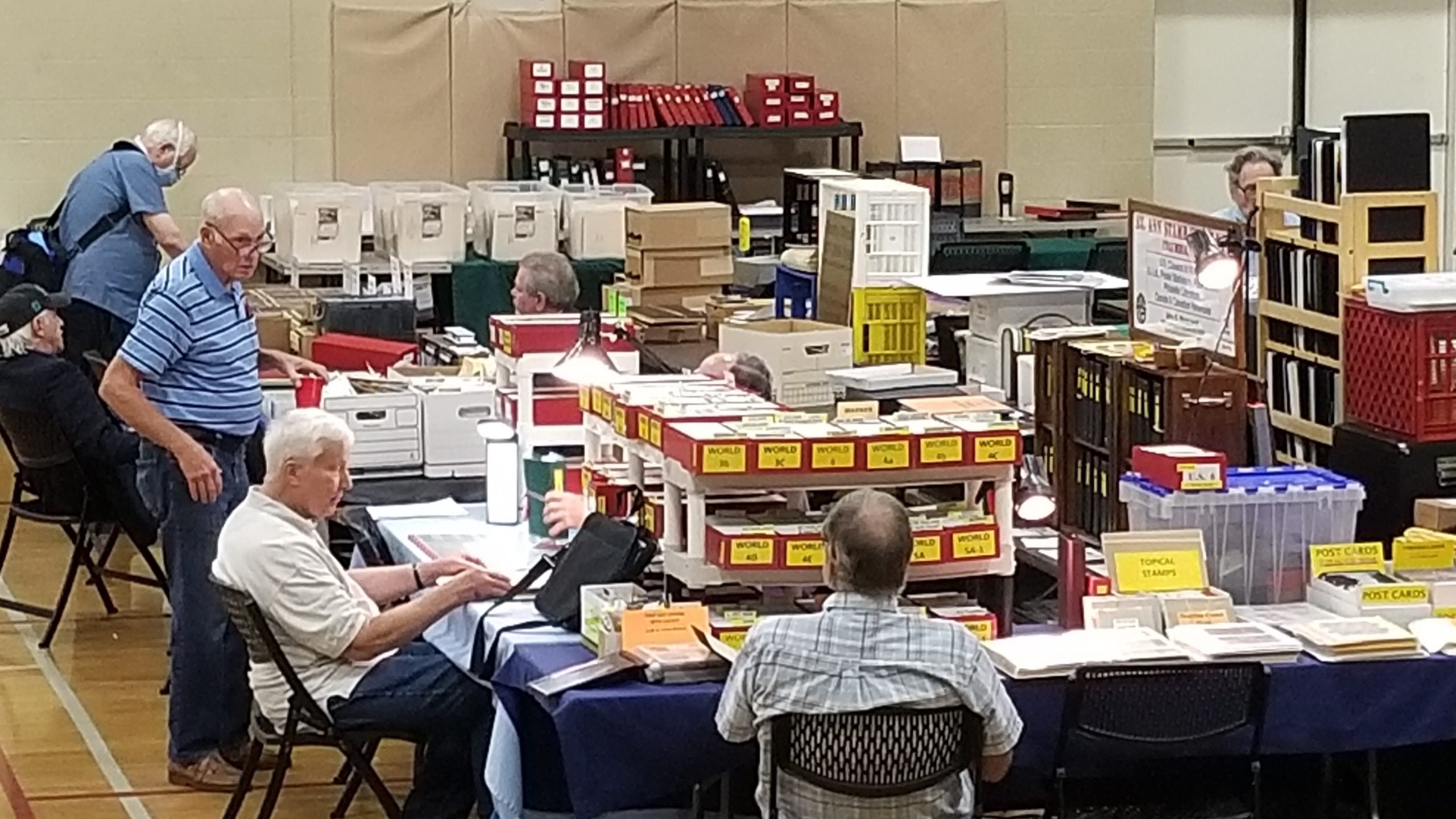
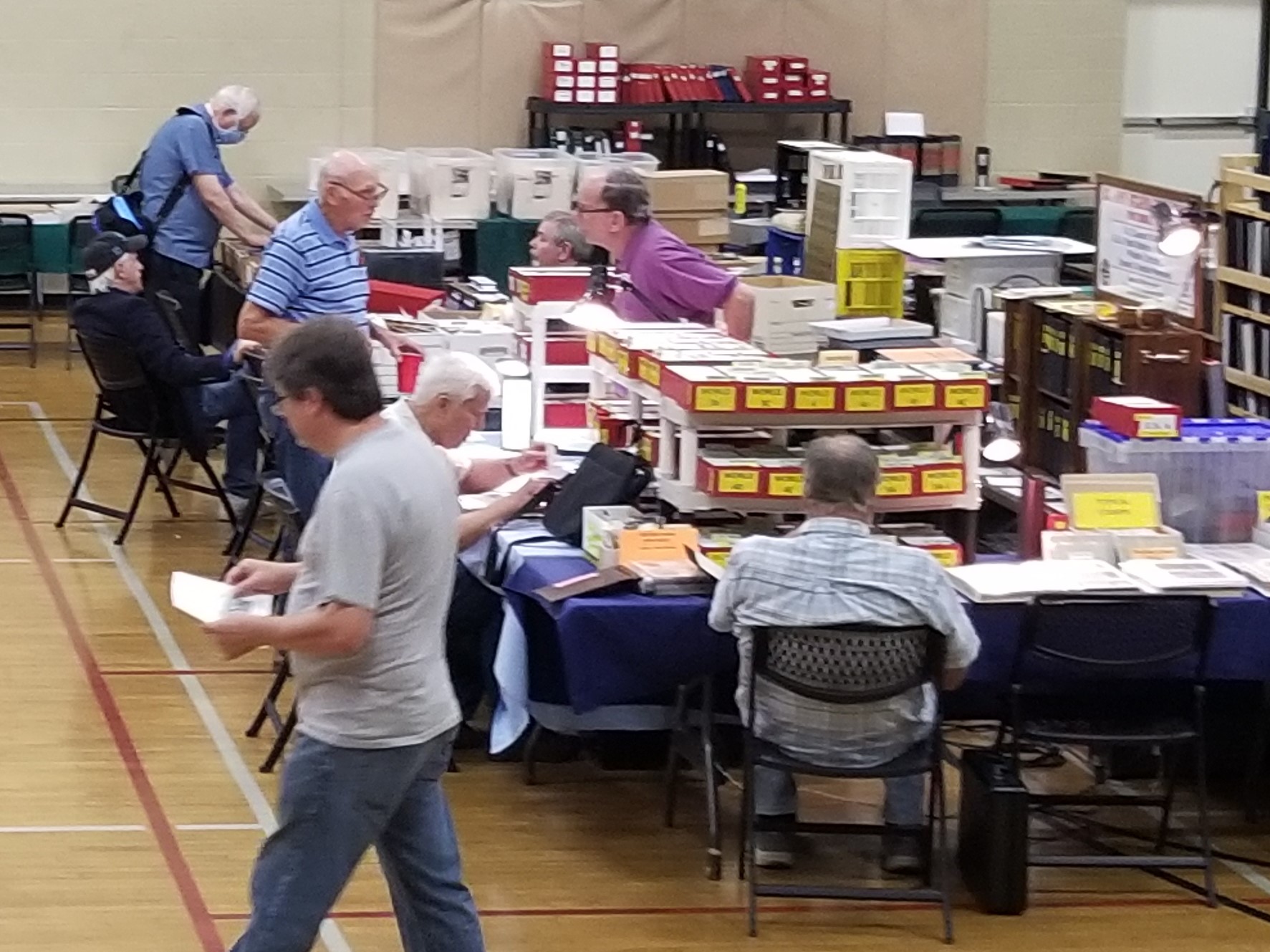
Linn’s Stamp News (Aug. 17, 2020 by Alex Haimann): St. Louis Stamp Expo attendees, dealers pleased with show’s success during pandemic
As a follow-up from the above Linn’s article, Alex was asked by Charles Epting & Michael Cortese, both APS YPLF grads who started the Conversations with Philatelists podcast to chat more about the 2020 STL Stamp Expo.