
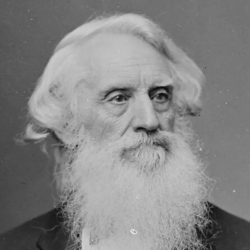
Inventor – Samuel F. B. Morse was the Superintendent of the Telegraph Office (1845-1846)

April 27, 1791 – April 2, 1872
Telegraph – U.S. Patent No. 1,647
Samuel F.B. Morse, once a portrait painter, turned to inventing to make his fortune. Morse had little training in electricity but realized that pulses of electrical current could convey information over wires.
Born in Charlestown, Massachusetts, the eldest child of the Reverend Jedidiah Morse and his wife, Elizabeth Ann Breese, Samuel Morse attended Phillips Academy in Andover, Massachusetts, and entered Yale College in 1805, graduating in 1810. Morse took out three patents on pumps in 1817 with his brother, Sidney Edwards Morse. Samuel Morse’s interest in telegraphy began in 1832, and the elements of a relay system were worked out late in 1835. The equipment was gradually improved and was demonstrated in 1837. Morse developed “lightning wires” and “Morse code,” an electronic alphabet that could carry messages. The patent was applied for in 1840. A line was constructed between Baltimore and Washington, D.C. and the first message, sent on May 24, 1844, was “What hath God wrought!”
To support himself later in life Morse was largely dependent on dividends from telegraph companies. In 1858 several European countries combined to pay a gratuity of 400,000 francs as compensation for their use of his system. In 1861 the two coasts of the United States were linked by telegraph.
Samuel Finley Breese Morse (1791–1872) never sorted letters, carried a mailbag, or worked behind a postal counter, but he changed the U.S. Post Office more profoundly than almost any employee ever could. His invention of the electric telegraph and Morse code reshaped how the nation communicated, turning days‑long mail delivery into near‑instant transmission.
Morse’s work marks the moment when the U.S. Post Office began evolving from a physical delivery system into a modern communications network.
The Telegraph: A Revolution in Postal Communication
Between 1832 and 1838, Morse developed the first practical single‑wire electric telegraph and, with Alfred Vail, created Morse code, a system of dots and dashes representing letters and numbers.
On May 24, 1844, he sent the first long‑distance telegraph message — “What hath God wrought?” — from Washington, D.C. to Baltimore.
On April 1, 1845, the first public telegraph office opened in Washington, D.C., operating under the control of the Postmaster General, General Cave Johnson, (formerly under the Treasury Department), and it served as the central headquarters for the Baltimore–Washington telegraph line.
This moment marked the beginning of a new era for the U.S. Post Office Department, which quickly adopted telegraphy as a supplement to traditional mail.
How Morse Changed the U.S. Post Office
Although not a postal worker, Morse’s inventions:
1. Created the first “electronic mail” system
Telegraph lines were initially operated under government contract and often housed in or near post offices.
2. Enabled same‑day communication across states
What once took days by stagecoach or train could now be transmitted in seconds.
3. Supported westward expansion
Telegraph lines followed postal routes, helping unify a rapidly growing nation.
4. Laid the foundation for all future postal technology
From telegrams to fax machines to email, every leap forward traces back to Morse’s work.
Before the Telegraph: Morse the Artist
Before turning to invention, Morse was a respected portrait painter, trained at the Royal Academy of Arts in London. His artistic discipline later influenced the precision and clarity of Morse code.
Why Morse Belongs in the Famous Postal Employees Series
Even though he never worked for the USPS, Morse:
- Revolutionized how the Post Office communicated
- Created the first technology that bypassed physical mail
- Helped unify the country through rapid information exchange
- Influenced every communication system that followed
He is, in every sense, a foundational figure in postal history.


